Wednesday, October 14, 2009

A Visit

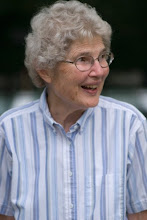
Got down to the hospital to see Grandma. I told her how I felt about her and grandpa and her brother Carl who used to live upstairs from me and died early in the morning, getting ready to go work in the temple. I told her how Michael and I talked about how someday we will be the older generation responsible for keeping things together and it's hard to imagine ourselves being up to the task. And she reminded me that you don't become the kind of person overnight: it takes time. And then she told me a story she's told me many times before, about how she, as a younger woman, spent some time caring for an elderly relative of hers who was quite cranky and bitter. The experience made her vow to herself that she wouldn't be a cranky old woman: which made her realize that she'd better stop being a cranky young woman first.

I laughed. We talked and talked, told each other new stories which led us back into telling stories
we've already told each other dozens, maybe hundreds of times--and I love the rhythm of it.

Next Friday, she told one nurse, she will have twenty-nine grandchildren and one great-grandchild.

When another nurse asked where she was from, she said "Would you like the short version or the long one?"

Maybe that's one thing we can keep from generation to generation.

Good News

Matt just called again to say that Grandma is awake and breathing fine in the hospital. Everything seems to be fine--they'll hold her for observation (thank God for doctors and their families who let them sacrifice for the rest of us!) and then she'll be able to come home. Things sound good.

After I got off the phone with him, I started sobbing. It's crazy, I'm here alone in an office on BYU campus and I turned off the lights and curled up on the floor while I cried. There's something about the sense of relief that makes it more OK to acknowledge how much something has shaken you.

I believe in God because I believe in the eternity of memory. That when beautiful and profound things happen, like my grandmother deciding to marry my grandfather even in a time when their "mixed race" marriage was illegal, somewhere written on the face of the universe, that stays. I really believe that's not just a good thought, that's how things are. What we do in life matters. The ways we are connected matter and are infinite and eternal: healed and purified relationships are heaven.

This is maybe why I care about history and ethnicity: they are threads that bind us to those who gave life to us, those who shaped our souls with their love.

And if you want to know who I am: I am someone who absolutely refuses to give up on that! I am, or at least want to be someone who never lets the very real and heavy burden of life get in the way of the healing burdens of inherited love.

Vulnerability

A long conference with a student meant I was running late to class today--at 1 pm, when I should have been in the classroom with my ringer off, I got a call from my younger brother saying our Grandmother had just fainted and not gotten up and that Grandpa had called an ambulance and gone with her to the hospital.

I remember something like this happening several years ago--I think they lived in California at that time--and everything came out just fine then. I'm assuming that the same will happen now, but it's still scary. It's not so much a feeling of worry over her, she's a good woman and will be all right no matter what--it's a sense of my own vulnerability in the possibility of her absence.

To think that her presence could suddenly be gone, her memories lost to immediate access, is overwhelming. I've certainly been grateful before that I've gotten so much time with my grandparents; I've tried to soak up what I can from them, to take advantage of the chances to talk. I've known that they are (in spite of all appearances to the contrary) mortal--but I've come to depend on them not to do scary things like this!

The world makes sense to me partly through the strength of my grandparents. I think of all they've done, all they've learned, all they went up against and emerged with more love and richer senses of humor--these are the kind of people who keep the spirit of God in the world. While I realize that my grandmother will still exist no matter what happens, it's difficult to imagine a world in which I don't have direct access to the way she tells her stories, the way she keeps her house, the way she plays games with her youngest grandchildren.

My brother will be ordained an Elder in our church on Sunday: it's a moment in which he is invited to embrace adult responsibilities in the community. I will be married next Friday: that's a moment in which I will accept responsibilities we see as binding (and rooting) us through the eternities.

It seems impossible to me at this particular moment that we will live up to all these responsibilities in anything like the way my grandparents have. Numerous ancient religions used to worship ancestors, to project them as somehow larger than life, and I feel like I can understand why.

Perhaps if we hold tenaciously on to their memory and spirits, the stories can give us access to some of their strength and power. But please God give her much more time to live: I don't want my daughter to grow up without her!

Tuesday, October 13, 2009

The Trouble with Racism

...is that it's become a counter-productive term.

There was a time, say sixty years ago, when plenty of people were still happy to openly admit that they thought of their own "race" as superior to all others. The term "racism" served as a productive way to label and combat those attitudes. Public schools, for example, decided that teaching about the dangers of racism should be part of their curriculum. Being opposed to racism has become a deeply embedded value in our society to the point that to call someone a "racist" is not simply a description of their ideology, but an accusation or insult.

That's a great achievement in many ways, but a major problem in others. I'm glad, on the one hand, that we no longer live in the days when people could hold lynchings in conjunction with picnics and weren't ashamed to take pictures of themselves doing so. I'm worried, though, that by teaching that racism is evil without acknowledging that cultural frictions are natural keeps people from acknowledging and working on living together in harmony.

It's common and normal, after all, to think that food from other cultures smells strange. It's a problem, though, if the biggest factor in your relationship with a neighbor is how much the smell of their food annoys you. It's common for people from different backgrounds (esp. different cultural/historical backgrounds) to be sensitive over different subjects. How do we negotiate those sensitivities and get over the unintentional offense we receive or cause? Minority cultures almost all struggle against definitions of what is normal or acceptable (in clothing, writing, music, hair, whatever) that are based on majority cultural standards. How can we learn not to try to force the wrong standards onto those who don't want to fit?

Our focus on racism has made it difficult to talk to about such cultural issues without putting people on the defensive. "I'm not racist" is the response you're likely to get if you try to raise an issue: which does nothing to resolve whatever friction exists. The word "racism" makes minority individuals excessively defensive, too: because "racism" is a often seen as a choice and racism is as actively evil, the term "racism"makes people from minority groups more likely to interpret tensions with individuals from the majority culture as signs of evil than as natural friction.

So, is it time to try to throw the term "racism" out, or at least put it into a narrower place?

If so...how?

Tuesday, October 6, 2009

The Parable of the Circle

Several weeks ago, I incorporated some excerpts of this blog along with some new material into an essay for a class. One piece of feedback I got from several students was that they wanted the resulting piece to involve more of me and my personal presence. Why so much time on brothers, great-grandparents, the politics of distant lands when I was directly described only in a conversation with my soon-to-be daughter?

Maybe they're right. Maybe I should spend more time directly engaging the experiences I've had in my twenty-six years on earth. Maybe there's something to be said for the orienting effect of a strong autobiographical presence in this kind of cultural writing.

I couldn't help but wonder, though, if that also says something about our cultural obsession with the narrowly defined self. Do we expect personal writing to be about someone's direct personal lifetime experience because we live in a culture dominated by egoism? Is it entirely true that the events which most profoundly shape us happen within our lifetimes?

Maybe we should loosen the grip of our desire to want to "know" a person by looking directly at them and what they do. Maybe we should look more at what comes around them: how they interact with their ancestors, history, the world around them as it exists now. Maybe viewing people less as self-contained artifacts than within the webs of people, places, and stories that make up their natural context would help us be more thoughtful and ethical in the way we turn and see our lives and world.

If I draw a circle, after all, my pencil should never touch the center--does that make the center less clear, meaningful, relevant?

Can we change the way we read to access this different approach to the world?

Saturday, September 26, 2009

Yom Kippur

Sunset tomorrow starts the holiest day of the year for Jews: Yom Kippur, the Day of Atonement.

I can only recall having gone to Yom Kippur services once or twice, but I fast every year and I try to be a good "Google Jew" and study the appropriate prayers and traditions on the internet the night before--tonight--in preparation.

Two parts of the Yom Kippur liturgy, in particular, mean a lot to me. One is Ashamnu, a prayer expressing collective confession for sins. The other is Kol Nidre, a renunciation of all the vows that we will make during the coming year.

Kol Nidre has been, and in certain circles still is, highly controversial. Some take it as evidence that Jews are inherently untrustworthy--why believe someone who has already publicly renounced all the year's vows?

To anyone who follows the rest of the liturgy, however, it is clear that Jews take honesty very seriously indeed. Kol Nidre, in fact, was developed specifically because Judaism advocates strict integrity--in classical Jewish thought, you are accountable for broken promises even if they were made thoughtlessly, or even if circumstances change such that keeping them becomes impossible. Kol Nidre is to remind us that we cannot always do what we hope to do, that we do not have the power to truly guarantee the fulfillment of even our most sincere promises. It was a comfort to medieval Jews forced to accept medieval Christianity or die. It is a comfort to parents who can't do everything they'd wanted for their children, and for children who can't be everything that hoped to be for their parents.

While writing a set of very short (300 word or less) stories last year, I decided that the idea of Kol Nidre speaks in a special way to many immigrants' experience. Below is the story I wrote based on this idea:


Kol Nidre

Abuela, whose grave I had promised to always visit—I'm sorry.
That garden plot, mother, I told you as a child I would tend when you got old and your joints turned hard—whisper my apologies to the weeds.
My wife, who can't go see her brother at his wedding, in case she somehow wouldn't be able to make it back past immigration—forgive me.
Mijo, I said you would have it better than me, but now—we'll see.

My father, who prepared me to live in a world he didn't know was disappearing—have I disappointed you?
Ernesto, who wanted to go through the best and worst with me—if you have a steady one, could you send me your address?
Everyone who is still somewhere, every sun that rises over my old home and does not see me, every drop of rain God sends to nourish crops I haven't sown—what happened to the life I'd thought I would lead?

All vows, all the vows I didn't dream I wouldn't be able to keep—please, please, release me.

Wednesday, September 16, 2009

Passports and Peach Trees (part one)

email from G.S. Gill to his eldest granddaughter on 11/23/05:

"I left India in June 1954 at age 19 with the intention of getting an education in U.S.A. My parents bought me a ticket to San Francisco with about five dollars left in my pocket. I took a bus to Stockton and was met by an elderly blind gentleman with an escort who brought me to Selma California to Labh Singh Gill's home. Labh Singh was in his sixties and had come to USA a long time before. He was from my home village. He helped me find farm work in the grape vineyards with local farmers and get admitted to Fresno State College. On Mondays, Wednesdays, and Fridays I attended college and worked on the farms the rest of the time. It was difficult to pick peaches with a turban because it was getting caught in the branches all the time. So, I got a haircut and took the turban off. This was the first loss of a tradition from my culture. On the whole I stayed within the Indian community both inside and outside the college."


Gurcharan Singh Gill's passport, age 19


email from G.S. Gill to his extended family on 9/8/09:


"These bewildered pictures shows how nervous I was after spending two years of crop money to come to USA and blow it all up on the PAN AM Airline ticket of US 350 dollars. It included two years of my helping Dad on the farm full time. At the San Francisco Airport I had $5 left. The consolation was that money grew on trees in USA and I could pick it off the trees during the Summer if I flew instead of taking the boat. Well, the money on trees was picking peaches on a Peach Farm in Yuba City California. I was not told about the heat, sweat, Peach Fuzz, and nightly leg cramps etc. But I made enough money to make up for the splurging on the Airline Ticket and paid for my tuition at Fresno State College which is now University of California at Fresno. I also knew that Dad had no money to send me for college. So, I had to swim or sink. I chose to swim. It reminded me of learning to swim, when my buffalo grazing buddies picked me up when I was sleeping under a shady tree at noon and threw me in the water canal because I was not swimming with them! If you feel like complaining because college is hard etc; just remember that I made a choice of education over farming and have not regretted it. However, it took me over forty years to get the farming out of my head. Enjoy your college days while you can because they end all too quickly!"


Gurcharan Singh Gill with his brother Bachittar Singh Gill on
their share of the family farm in Dhudike, March 2005.
Related Posts with Thumbnails